Abdominal and liver measurements
Tesamorelin abdominal-fat measurements
The useful word here is visceral. The scans locate the change, and the trial population gives it a boundary.
The abdominal scans
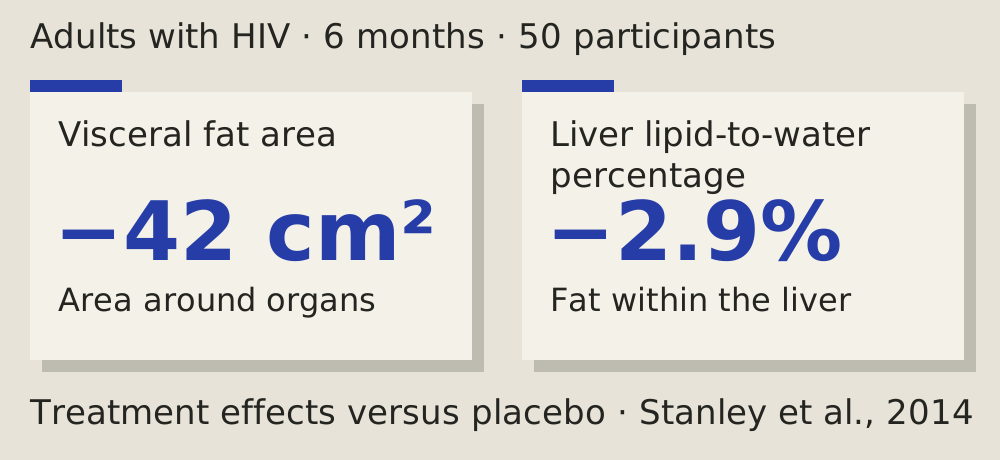
The tesamorelin scans give me an anatomical result to examine. In a 6-month randomized trial of 50 adults taking HIV treatment, 28 participants received tesamorelin and 22 received placebo. All had HIV and abdominal fat accumulation. The treatment effect versus placebo was −42 cm² for visceral fat and a net −2.9% for hepatic lipid-to-water percentage, the liver-fat measurement.
Those outcomes describe different things. One is an area of fat around abdominal organs; the other is a measure of fat within the liver. I like seeing cm² next to the visceral-fat result. The units make it harder to drift from a specific anatomical result into a vague claim about a smaller body.
Combined tesamorelin results
A 2026 meta-analysis pooled five randomized trials in HIV-associated lipodystrophy. It reported a mean difference of −27.71 cm² in visceral adipose tissue, with a 95% confidence interval of −38.37 to −17.06 cm². Trunk fat changed by −1.18 kg, hepatic fat fraction by −4.28% and lean body mass by +1.42 kg.
The spread of measurements is useful. Fat area, trunk-fat mass and liver-fat fraction each describe a different compartment. Lean body mass includes tissue other than fat; the number alone does not establish stronger muscles. These measured anatomical changes impress me within the studied population. Their specificity gives the result its value.
Stopping tesamorelin
The 52-week tesamorelin program reported visceral fat remaining 18% below baseline during continued treatment. Visceral fat reaccumulated after discontinuation. That return matters as much to my assessment as the initial reduction: the observed change depended on continued treatment.
The study involved adults with HIV and abdominal fat accumulation. Glucose changes over the program were not clinically significant. This is useful safety information for that setting and duration, with longer-term questions still open.
Hormones, glucose and the approved use
Tesamorelin stimulates the pituitary to release growth hormone and thereby raises IGF-1. In 13 healthy men studied for 2 weeks, mean overnight growth hormone rose by 0.5 micrograms per liter and IGF-1 by 181 micrograms per liter. Neither fasting glucose nor insulin-stimulated glucose uptake changed significantly. The small, short study tested physiology in healthy men; it had a different purpose from the abdominal-fat trials.
The LiverTox monograph describes United States approval for reducing excess abdominal fat in adults with HIV-associated lipodystrophy and judges clinically apparent liver injury unlikely on the evidence reviewed. Tesamorelin is a prescription medicine for that defined indication. General weight loss and anti-aging have no approved indication, and research-grade material does not inherit the approved drug’s status.
The label contraindicates active malignancy. IGF-1 elevation, possible glucose effects and uncertainty about long-term cancer risk remain relevant safety questions. Tesamorelin is prohibited in tested sport. I’ll take a broader claim seriously when trials have tested the population it names; the HIV studies already have a substantial, specific result of their own.